Have any questions?
+44 1234 567 890
2026-07-10 08:34
(comments: 0)
Downwind Sail for Bluewater Cruising
Why an Atlantic Crossing Changes the Demands
Between the Trade Winds and the Night Watch
When people think of a downwind sail for bluewater cruising, they often picture an easy downwind run: a colorful triangular sail, wind from astern, long rolling waves, and blue skies. But on an Atlantic crossing, the reality is more complex. Between a nice downwind daysail and 12 to 24 days at sea without a break, the difference is not just more nautical miles. The demands on the boat, the crew, and the sail setup change completely.
This difference can also be seen clearly in the Atlantic Rally for Cruisers (ARC): long passages, constant motion, limited resources on board, and no option to simply pull into the next harbor if gear fails. A downwind sail for bluewater cruising therefore needs to do more. It has to stay stable for hours and days, remain controllable, and fit the crew, the boat, and the passage.
Bluewater Cruising Is Not a Longer Weekend Sail
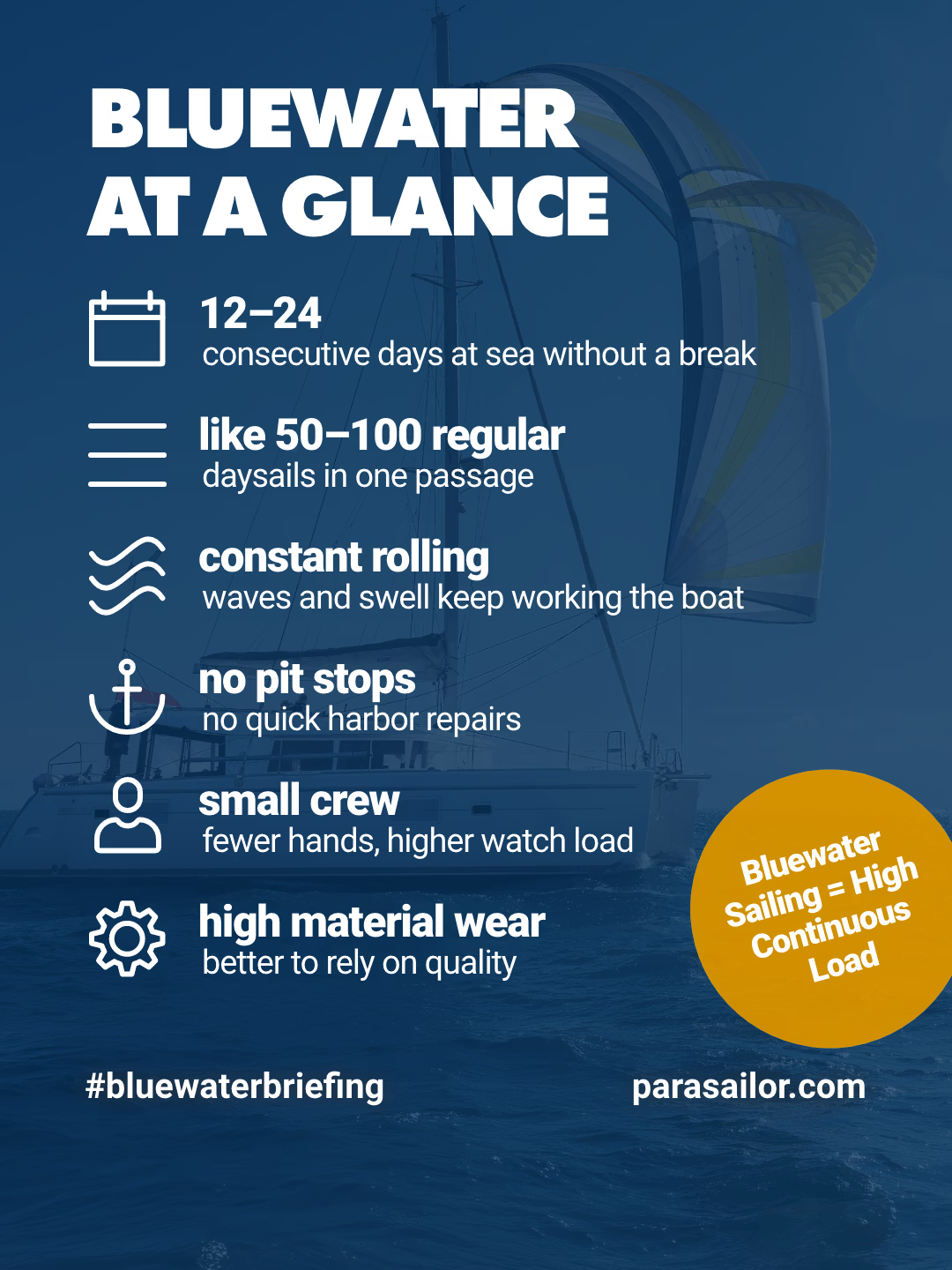
Bluewater sailing does not simply mean “more of the same.” In ARC reality, we are talking about 12 to 24 consecutive days at sea without a break. That is roughly the same level of strain as 50 to 100 regular daysails with just a few hours on the water each.
And the boat is always moving. Rolling, swell, and waves do not stop just because the crew gets tired. On a bluewater passage, constant motion is the norm.
The Atlantic Rally for Cruisers is not a regatta in the classic sense. It is an organized Atlantic crossing for cruising sailors, where preparation, seamanship, safety, and arrival matter most. Of course, nobody wants to sail unnecessarily slowly. But the approach is different from racing: on a bluewater passage, the best setup is not the one that is fastest under ideal conditions. It is the one that works reliably for days and weeks.
Racing crews can push gear closer to the limit because speed is the main goal and the crew is trained to react quickly. Cruising crews think differently: How large is the crew? How experienced is it? How much energy will be left after several days at sea? And how can breakages, wear, and unnecessary stress be avoided?
That is why different criteria matter for a downwind sail for bluewater cruising: stability, manageable handling, autopilot compatibility, material protection, and the widest possible usable wind angle range.
As can be seen in the video, the wing stabilizes the sail despite strong wave motion and generates lift.
Downwind Across the Atlantic: Planning Around the Trade Winds
The classic Atlantic route from the Canary Islands to the Caribbean relies on the northeast trade winds — a wind system that makes long reaching and downwind angles likely on the east-to-west passage. That is why the ARC starts in November from Las Palmas on Gran Canaria to Rodney Bay on St. Lucia. Around 240 boats use this weather window each year for the roughly 2,700-nautical-mile crossing.
But the trade winds are not an autopilot for the Atlantic. Strength, direction, and stability can change. Weather windows need to be assessed continuously, and climate change is making planning even less straightforward. Large-scale tropical circulation is changing. For the Northern Hemisphere, studies indicate a weakening of the Hadley circulation — the system that helps shape the trade winds.
For crews, this does not mean the trade winds are gone. It means they should not be treated as a guarantee. On long downwind passages, waves, swell, gusts, squalls, night watches, and material strain all come together. A downwind sail for bluewater cruising therefore needs to stand well not only in ideal trade-wind conditions, but also remain controllable when wind angle, pressure, and sea state change.
What a Bluewater Downwind Sail Needs to Do
• a wide usable wind angle range, from broad reaching to deep downwind angles
• stable sail behavior, even in waves, swell, and changing apparent wind
• calm handling so the autopilot does not have to work constantly
• controllable handling with a small or tired crew
• reduced rolling and lower load changes throughout the boat
• clean line routing and as few chafe points as possible
• enough reserve for gusts, squalls, and course changes
• long-term usability on passage, not just short bursts of ideal performance
This is where theory and practice often part ways on a bluewater passage. A sail may promise a lot of performance on paper. But if it demands constant attention, collapses easily, or keeps the crew busy all the time, it quickly becomes an energy drain on a long passage.
Small Crew, Big Difference
Many Atlantic crews sail shorthanded, or at least with limited crew resources. That changes priorities significantly. It is no longer just about speed, but also about physical stamina, wellbeing, watch systems, sleep, and how many problems the crew can realistically afford to deal with underway.
From an ARC perspective, it comes down to this: limited resources for problem solving, avoiding wear, protecting the crew, and protecting the gear. For bluewater sailors, performance and sail area are only part of the equation. Handling, sail stability, autopilot compatibility, and the amount of constant attention the sail requires matter just as much.
A good downwind sail for bluewater cruising reduces the load not only on the boat, but also on the people on board. It needs to remain manageable even when the most experienced person is not at the helm, or when the crew is far less fresh after several days at sea than they were at the start.
Material Protection: Chafe Prevention Is Not a Detail
Anyone sailing several thousand nautical miles downwind quickly realizes that it is not one big moment that decides things, but the sum of many small loads. Chafe points, poor line routing, poorly matched fittings, or constantly unstable sail movement can become a real problem on passage.
What is barely noticeable on a daysail can become critical offshore. Chafe prevention is therefore not a side issue. Anything that chafes will wear. And anything that fails offshore cannot simply be repaired by outside help.
When choosing and setting up a downwind sail for bluewater cruising, the sail itself is only one part of the system. Just as important are the snuffer, sheets, blocks, attachment points, soft shackles, masthead fittings, reefing lines, and all the places where fabric or lines work under load for many hours.
Why Parasailor Is Especially Well Suited for Long Bluewater Passages
Parasailor’s concept addresses the typical demands of long downwind passages: deep sailing angles, stable sail behavior, reduced boat motion, controlled handling, and better cooperation with the autopilot. Parasailor covers several points that are especially relevant for a downwind sail for bluewater cruising:
Wide Wind Angle Range:
Parasailor is designed for broad reaching to deep downwind angles, making it well suited for typical downwind passages.
Calmer Sail Flight Through Wing-Generated Lift:
The integrated hybrid wing stabilizes the sail and generates lift. This helps Parasailor fly more steadily, reducing rolling and pressure on the bow.
Gust Damping Through the Sail Opening:
The opening in front of the wing reduces sudden pressure build-up in the sail and helps dampen the impact of gusts. This also reduces peak loads in the rig.
Less Trimming Effort:
A more stable sail requires fewer constant corrections — especially important with a small crew and long watches.
Autopilot-Friendly Behavior:
Parasailor reduces sudden load changes and the resulting course corrections. This allows the autopilot to steer more smoothly over longer periods.
No Traditional Spinnaker Pole Needed:
Robust Materials, High-Quality Manufacturing:
On long passages, every detail matters. Parasailor is made from durable materials and manufactured in Europe to high standards — for a downwind sail that remains reliable even after many hours under load.
The Best Downwind Sail for Bluewater Cruising
Parasailor is not the only possible downwind setup. But it plays a special role in bluewater sailing: it combines a large downwind sail area with stable, calm sail behavior created by the lift of the wing. The result is controllable, autopilot-friendly handling on long downwind passages.
Conclusion
The right question is not: Which downwind sail is the fastest? For an Atlantic crossing, the better question is: Which setup can I sail for the longest time — safely, efficiently, and with the least strain on the crew?
A downwind sail for bluewater cruising has to do more than generate drive. It has to work with waves, swell, changing apparent wind, the autopilot, a small crew, and constant material load. On long passages, the best sail is not the most spectacular one, but the setup that remains controllable for many hours.
That is why downwind sails should not be viewed in isolation, but as part of a complete downwind system: sail, snuffer, line routing, fittings, crew experience, boat type, and sailing profile. Only when these elements work together does the setup become truly suitable for bluewater cruising.